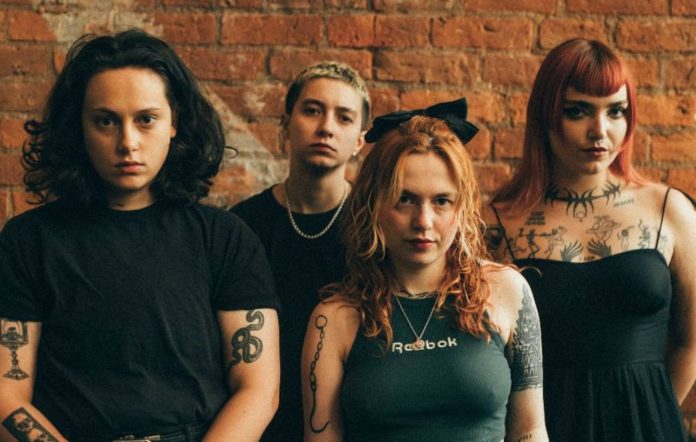

Witch Fever have said they were left “broke” after spending two months playing arena shows across the UK and Europe.
The Manchester doom punk band joined Danish metal group Volbeat as support on their headline arena tour towards the end of 2025. Despite performing regularly in large venues during that period and being paid their agreed fees, the band explained they ultimately lost money due to Brexit related tax costs.
They discussed the financial reality on a recent episode of the 101 Part Time Jobs podcast, where they spoke about how increasingly common it has become for musicians to struggle financially.
Speaking about the need to leave their regular jobs in order to commit to the tour, bassist Alex Thompson said: “We did two months in arenas and stadiums. We played Wembley Arena. Then we got to the end of it and found that the pot of money which was going to be our profit is all stuck in withholding taxes across Europe.”
“It’s a Brexit issue,” Thompson continued. “We’re basically paying double tax. We pay tax in the UK and we’ve had to pay tax on all of the fees internationally.”
Vocalist Amy Walpole then went on to explain that she has been relying on inheritance money from her late mother to cover basic living costs, after the tour brought in very little profit.
“We’re broke and we just did two months in arenas,” she said. “And we also can’t get a job because we’re back on tour in March, so nowhere will hire us.
“I’m just really laying it all bare here. We’re signed to a major label, but this is what the music industry is like at the moment. I’m currently living off £4,000 from my late mother’s pension that I got at the end of last year. That is rapidly running out. So it’s quite a depressing landscape at the moment. We’ve done a fair few years of touring and the fees are low, but the costs are getting higher and higher.”
Witch Fever are currently signed to Music for Nations, which operates as a subsidiary of Sony Music.
They are far from the only artists to raise concerns about the rising expenses and mounting pressure faced by musicians in the UK. Last year, Wolf Alice guitarist Joff Oddie appeared alongside industry figures at a government hearing, warning that even with small improvements, it remains extremely difficult for artists to earn a living through live performance.
“The big thing that I’d like to get into your heads is that when my band were doing the grassroots touring scene 12 years ago, it was unbelievably tight,” he said. “So 12 years ago the numbers didn’t stack up, and now it’s unbelievable. I can honestly say I’m not sure how Wolf Alice would make it work today.”
In November, figures revealed that the UK music industry generated a record breaking £8billion for the economy in 2024. Despite this success, serious concerns remain around the impact of AI on music, the continued threat to grassroots venues, post Brexit touring difficulties for UK artists, and slowing economic growth across the sector.
The damaging effect of Brexit on touring musicians was also highlighted in 2022, when industry leaders warned that leaving the European Union was “strangling the next generation of UK talent in the cradle”.
 The crowd during Limp Bizkit’s set at Reading Festival 2025. Photo credit: Andy Ford for NME.
“Coming off the back of COVID, we suddenly found ourselves in a situation where it’s harder for in demand UK artists and our world class technicians, haulage companies and everything that’s built up around our live music scene to get out there, play and delight crowds across Europe,” said Jon Collins, CEO of the music organisation LIVE, at the time.
“We do find a way, as the live music industry are experts at overcoming obstacles, but a particular concern is the damage that is being done at the moment, especially to younger emerging bands who do not have the same resources as more established artists.”
The difficult reality facing artists and grassroots venues looks set to continue into 2026, with the Music Venue Trust publishing its annual report earlier this week and revealing that more than half of UK grassroots venues failed to make a profit in 2025.
The report noted that increases in Employer National Insurance had led to widespread job losses, while higher business rates had also caused serious harm.
Those pushing for meaningful reform include the team behind London’s Royal Albert Hall, which last year became the first arena to commit to a LIVE ticket levy in support of grassroots venues.
Under the scheme, £1 from every ticket sold is reinvested into the UK live music ecosystem, helping smaller venues remain open and support emerging artists. Musicians backing the levy include Coldplay, Sam Fender and Katy Perry, all of whom have donated a portion of their tour income to grassroots causes.